

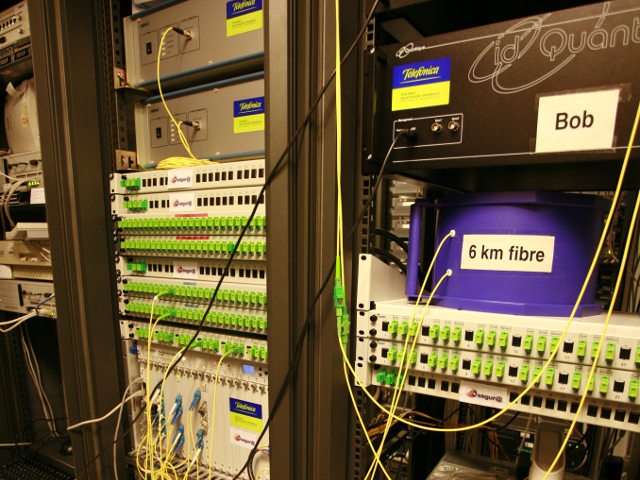


Quantum key distribution (QKD) is a cryptographic primitive that allows to exponentially grow a key, initially shared between the end points of a quantum channel–a communications channel over which quantum signals can be transmitted. Its security can be derived from the laws of quantum mechanics, which allow to prove the information‐theoretic security of QKD. In this entry, the process and specific characteristics of QKD are discussed. This includes the meaning of the “absolute security” character that is usually ascribed to QKD, its limitations and practical implementations.
The Control of Fluids in Microgravity with Vibrations (CFVib) experiment was selected for the 2016 Fly Your Thesis! programme as part of the 65th ESA Parabolic Flight Campaign.
Nowadays, classical configurations of civil transportation airplanes are well optimized, with further improvements expected to be of the order of a single drag count. To achieve it, the entire airplane has to be taken into account during the aerodynamic shape optimization, which requires handling complex geometries with computer-aided-design software.
In recent years, side-channel attacks have gained increasing attention, mainly due to their ability to extract sensitive information from their victims in an effortless way. Also, with the development and spread of cloud computing, where victims and potential attackers share physical infrastructure, these attacks are becoming a serious concern.
Standard haptic rendering algorithms are not well suited for underactuated haptic devices. They compute forces oblivious of underactuation, and then they simply project the resulting forces to the actuated subspace.
T-wave alternans (TWA) is a fluctuation of the ST-T complex occurring on an every-other-beat basis of the surface electrocardiogram (ECG). It has been shown to be an informative risk stratifier for sudden cardiac death, though the lack of gold standard to benchmark detection methods has promoted the use of synthetic signals.