




Today’s networks are quickly evolving toward more dynamic and flexible infrastructures and architectures. This software-based evolution has seen its peak with the development of the software-defined networking (SDN) and network functions virtualization (NFV) paradigms.
Pollution on water resources is usually analyzed with monitoring campaigns, which consist of programmed sampling, measurement, and recording of the most representative water quality parameters. These campaign measurements yields a non-uniform spatio-temporal sampled data structure to characterize complex dynamics phenomena.
Constrained mean-field calculations, based on the Gogny-D1M energy density functional, have been carried out to describe fission in Ra, U and Pu nuclei with neutron number 144 ≤ N ≤ 176.
The building sector is primarily responsible for a major part of total energy consumption. The European Energy Performance of Buildings Directives (EPBD) emphasized the need to reduce the energy consumption in buildings, and put forward the rationale for developing Near to Zero Energy Buildings (NZEB).
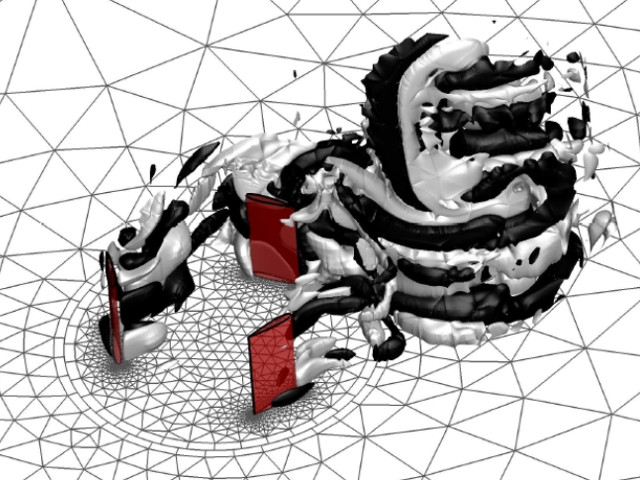
We explore the stability of wakes arising from 2D flow actuators based on linear momentum actuator disc theory. We use stability and sensitivity analysis (using adjoints) to show that the wake stability is controlled by the Reynolds number and the thrust force (or flow resistance) applied through the turbine.
We present the public release of the MultiDark-Galaxies: three distinct galaxy catalogues derived from one of the Planck cosmology MultiDark simulations by applying the semi-analytic models GALACTICUS, SAG, and SAGE to it.