
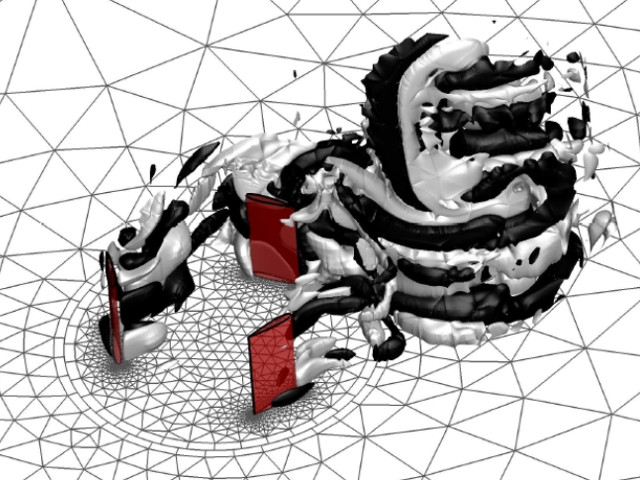



Kitefoil boards are a novel, emerging and disrupting class of sailing crafts, with major economical implications for the tourism sector due to their capability to enable kitesurfing in light wind areas. This paper investigates the hydrodynamics of the underwater appendage of a state-of-the-art kitefoil with a potential flow panel method implemented in the open source code Apame and with the Navier-Stokes solver ANSYS Fluent.
Energy engineers can use metering systems to monitor a building’s energy efficiency and actively look for opportunities to further energy-saving opportunities. The intent of metering systems is to provide adequate data that can be used to improve building systems performance.
Audio or visual data analysis tasks usually have to deal with high-dimensional and non-negative signals. However, most data analysis methods suffer from overfitting and numerical problems when data have more than a few dimensions needing a dimensionality reduction preprocessing.
The SODI-DCMIX thermodiffusion series experiments are part of the fluid research program carried out by the European Space Agency on board of the International Space Station (ISS). In particular, DCIMIX2/3 were conducted in the past inside the Microgravity Science Glovebox in the US Laboratory.
This paper proposes a framework in which a multivariate analysis method (MVA) guides a selection of input variables that leads to a sparse feature extraction. This framework, called parsimonious MVA, is specially suited for high dimensional data such as gene arrays, digital pictures, etc.
This is an erratum to our paper ‘The large-scale environment from cosmological simulations I. The baryonic cosmic web’, which was published in MNRAS 473, 68 (2018). Here, we correct an error in both Figs 4 and 5 of the mass fractions, which have inverted x-axes in the original publication.