
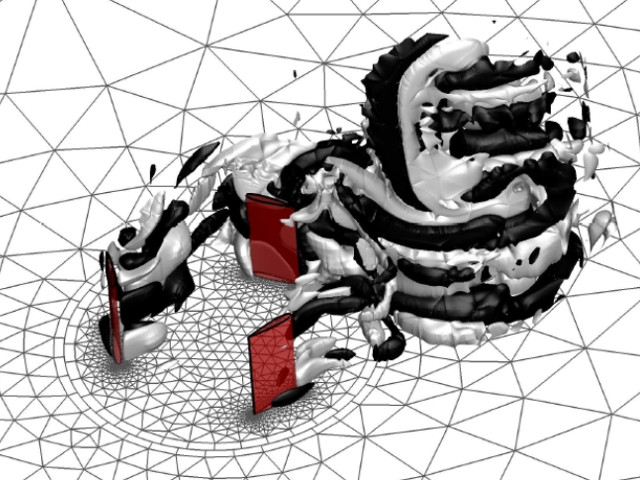





We present a provably stable discontinuous Galerkin spectral element method for the incompressible Navier–Stokes equations with artificial compressibility and variable density. Stability proofs, which include boundary conditions, that follow a continuous entropy analysis are provided.
Feature selection consists of choosing a smaller number of variables to work with when analyzing high-dimensional data sets. Recently, several visualization tools, techniques, and feature relevance measures have been developed in order to help users carry out the feature selection.
Automated mineralogy, including quantitative compositional and textural information, is a requirement for an efficient ore processing, and is comprised as an important input for geometallurgical planning. Classical ore microscopy is seen by many potential users as an outdated, time consuming, tool. Thus, SEM-based systems are often the choice for those who can afford them, in spite of their evident limitations for some minerals (e.g. for iron oxide ores).
We present an extension of the Löwdin strategy to find arbitrary matrix elements of generic Slater determinants. Our method applies to an arbitrary number of fermionic operators, even in the case of a singular overlap matrix.
The spectroscopic properties of the odd-odd isotopes Cs124-132 have been studied within the interacting boson-fermion-fermion model based on the Gogny-D1M energy density functional framework.
The diverging requirements from various vertical industries have driven the paradigm shift in the next‐generation (5G) mobile networks, where network slicing has emerged as a major paradigm for this purpose by sharing and isolating resources over the same 5G physical infrastructure.