



The low-spin structure of the nearly spherical nucleus 146Gd was studied using the 144Sm(4He, 2n) fusion-evaporation reaction. High-statistics γ−γγ−γ coincidence measurements were performed at iThemba LABS with 7× 10⁹ γγ-γγ coincidence events recorded.
Current and future large redshift surveys, as the Sloan Digital Sky Survey IV extended Baryon Oscillation Spectroscopic Survey (SDSS-IV/eBOSS) or the Dark Energy Spectroscopic Instrument (DESI), will use emission-line galaxies (ELGs) to probe cosmological models by mapping the large-scale structure of the Universe in the redshift range 0.6 < z < 1.7.
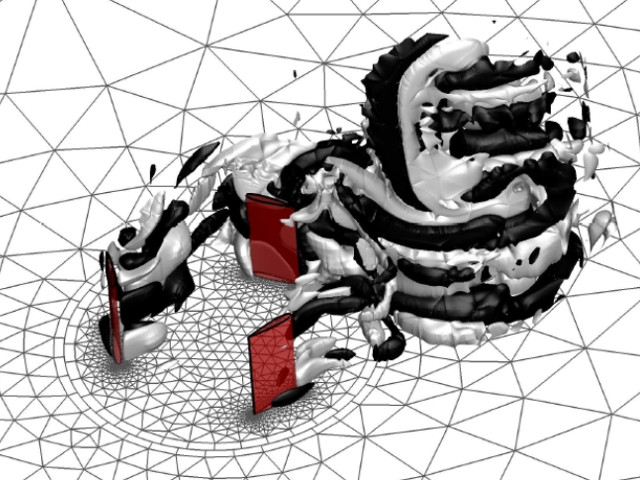
Current optimization tasks at the industrial level pose several challenging requirements, including high accuracy of flow evaluation (single drag counts), short optimization time to actively progress with the design loop (single days), robustness of the process, definition of design variables in CAD.
Emission line galaxies are one of the main tracers of the large-scale structure to be targeted by the next-generation dark energy surveys. To provide a better understanding of the properties and statistics of these galaxies, we have collected spectroscopic data from the VVDS and DEEP2 deep surveys and estimated the galaxy luminosity functions (LFs) of three distinct emission lines.
In this paper we present a large data base of weak lensing light cones constructed using different snapshots from the Big MultiDark simulation (BigMDPL).
The sterile neutrino is a viable dark matter candidate that can be produced in the early Universe via non-equilibrium processes, and would therefore possess a highly non-thermal spectrum of primordial velocities.