

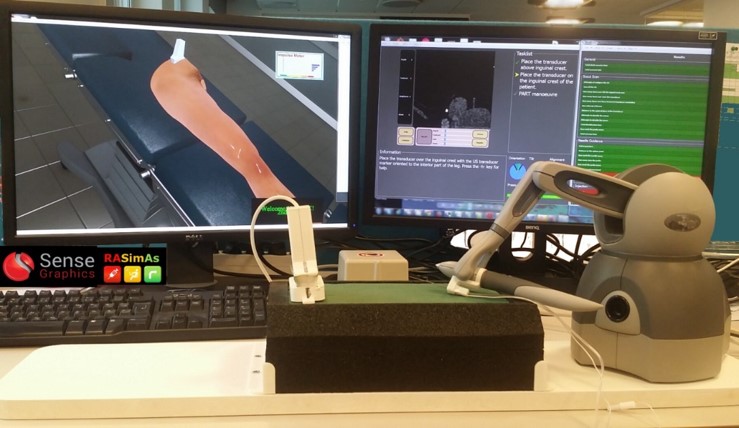



This course intends to disseminate the recent advances in haptic technologies among the computer graphics community.
The migraine disease is a chronic headache presenting symptomatic crisis that causes high economic costs to the national health services, and impacts negatively on the quality of life of the patients. Even if some patients can feel unspecific symptoms before the onset of the migraine, these only happen randomly and cannot predict the crisis precisely.
3D network-on-chip (NoC) has emerged as a cutting edge technology that provides better performance by combining features of NoC and die-stacking IC technology. It is able to push the limits of Moores law by increasing the density of components in a chip resulting in higher functionality.
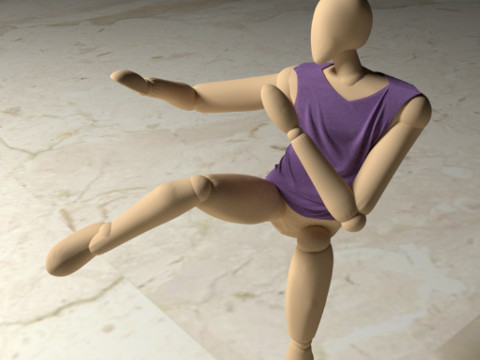
Rendering realistic fabrics is an active research area with many applications in computer graphics and other fields like textile design. Reproducing the appearance of cloth remains challenging due to the micro-structures found in textiles, and the complex light scattering patterns exhibited at such scales.
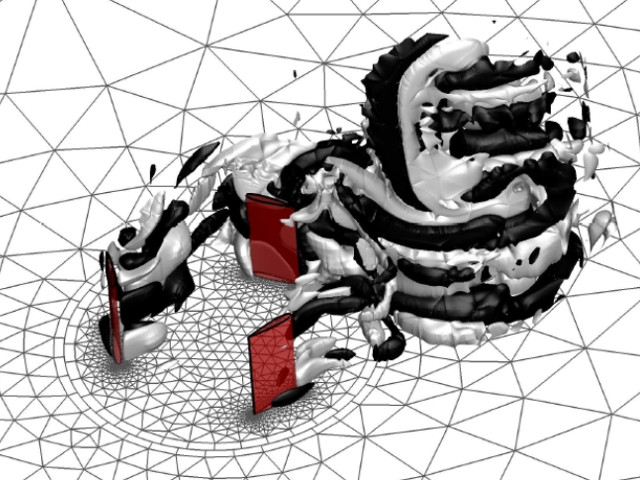
The carbuncle phenomenon is a critical numerical instability preventing the accurate simulation of hypersonic flows around blunted configurations. After reviewing the known remedies to handle numerically this instability (designed, all of them, for Finite Volume methods), we present and analyze in depth the only effective cure reported in literature for Residual Distribution schemes.
Performing experiments on small-scale quantum computers is certainly a challenging endeavor. Many parameters need to be optimized to achieve high-fidelity operations.