
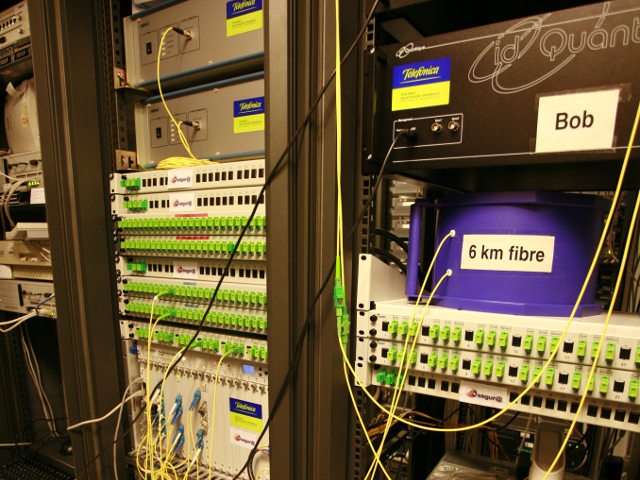


We discuss the on-going worldwide activity to develop forward looking standards for quantum key distribution (QKD) in the European Telecommunications Standards Institute (ETSI) QKD industry specification group (ISG).
Nowadays, there is an increasing demand for underwater intervention systems around theworld in several application domains. The commercially available systems are far from what is demanded in many aspects, justifying the need of more autonomous, cheap and easy-to-use solutions for underwater intervention missions.
In wireless body sensor network (WBSNs), the human body has an important effect on the performance of the communication due to the temporal variations caused and the attenuation and fluctuation of the path loss. This fact suggests that the transmission power must adapt to the current state of the link in a way that it ensures a balance between energy consumption and packet loss.
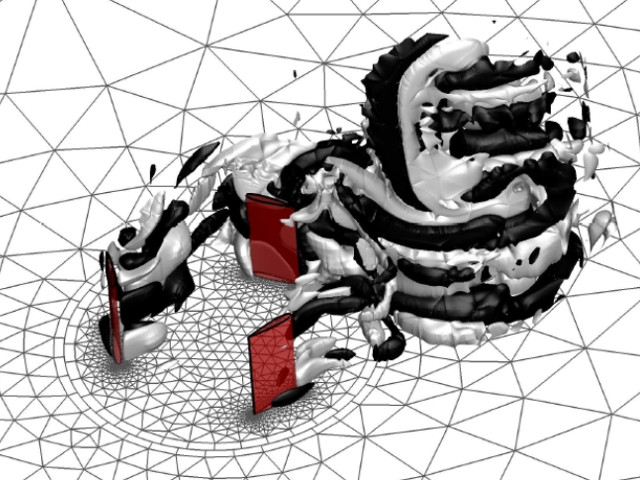
In this paper, a new generation of the particle method known as Particle Finite Element Method (PFEM), which combines convective particle movement and a fixed mesh resolution, is applied to free surface flows.
We study the behavior of two biological populations “u” and “v” attracted by the same chemical substance whose behavior is described in terms of second order parabolic equations.
Autonomous underwater vehicles (AUVs) are routinely used to survey areas of interest in seas and oceans all over the world. However, those operations requiring intervention capabilities are still reserved to manned submersibles or remotely operated vehicles (ROVs).