





Multi-core and many-core architectures have become conventional to meet performance requirements of emerging applications ranging from massively parallel data centers to ultra-low power embedded devices for the Internet-of-things.
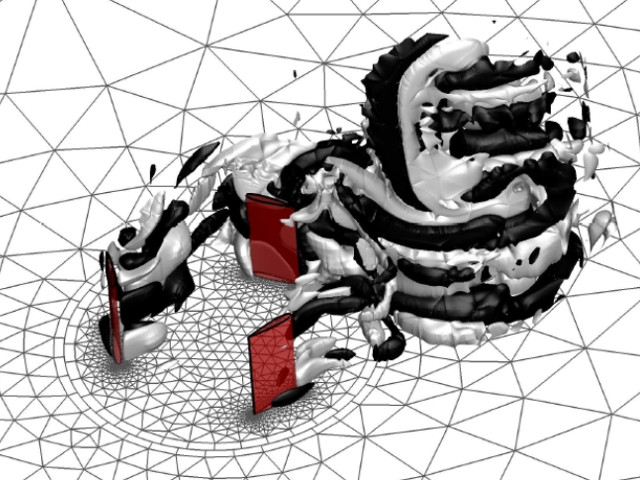
This work presents an implicit Large Eddy Simulation (iLES) high order (≥2) Discontinuous Galerkin–Fourier solver with sliding meshes. The work considers the incompressible version of the Navier–Stokes equations, which have remained elusive to DG-iLES approaches.
The halo shape plays a central role in determining important observational properties of the haloes such as mass, concentration and lensing cross-sections. The triaxiality of lensing galaxy clusters has a substantial impact on the distribution of the largest Einstein radii, while weak lensing techniques are sensitive to the intrinsic halo ellipticity.
The discrete event system specification formalism, which supports hierarchical and modular model composition, has been widely used to understand, analyze and develop a variety of systems. Discrete event system specification has been implemented in various languages and platforms over the years.
Parent material is a soil forming factor which, specially in temperate climates, influences soil hydraulic properties. As direct measurements of the soil hydraulic properties are laborious, time-consuming and expensive, this work explores the influence of geological material on soil hydraulic properties using the Balanced Entropy Index (BEI) as a particle size distribution descriptor which was shown to be useful in the estimation of soil water retention properties.
With 3D NoCs help improve circuit performance, fault tolerance and energy efficiency through the reduction of average wire-length and the increase in communication bandwidth of on-chip wiring, the soaring increase of on-chip temperature remains one of the most challenging obstacles to their commercialization.