


We model debris flows using two sets of nodes, describing the water and the solid phases, which can move relative to each other. We present first the mathematical model which will be used, deriving it from Zienkiewicz-Shiomi model, and arriving to the depth integrated model proposed by Pitman and Le.
We model debris flows using two sets of nodes, describing the water and the solid phases, which can move relative to each other. We present first the mathematical model which will be used, deriving it from Zienkiewicz-Shiomi model, and arriving to the depth integrated model proposed by Pitman and Le.
Groundwater resources are under stress in many regions of the world and the future water supply for many populations, particularly in the driest places on Earth, is threatened.
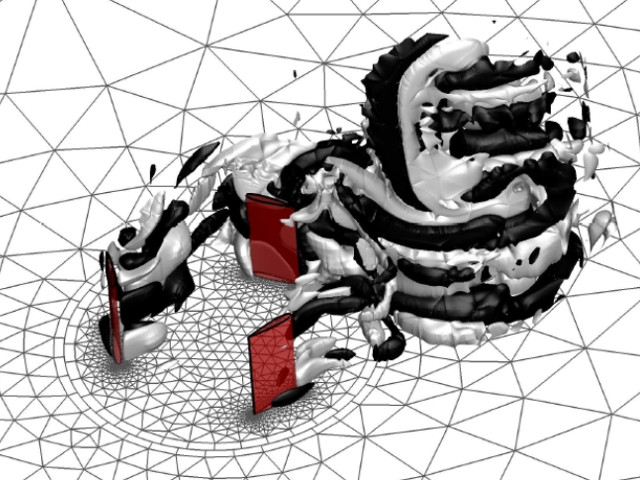
In the present work, the energy conservation properties of the Smoothed Particle Hydrodynamics (SPH) are investigated in the presence of fluid–solid interactions. Similarly to the fluid phase, the solid bodies are modeled through solid particles so that the whole solid–fluid domain can be described as a unique particle system.
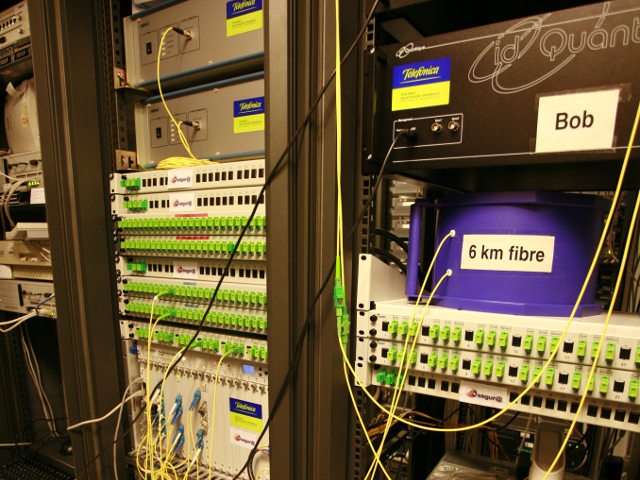
Quantum key distribution (QKD) is a state-of-the-art method of generating cryptographic keys by exchanging single photons. Measurements on the photons are constrained by the laws of quantum mechanics, and it is from this that the keys derive their security.
Managing energy efficiency under timing constraints is an interesting and big challenge. This paper proposes an accurate power model in data centers for time-constrained servers in Cloud computing.