




Multicarrier modulation based on discrete cosine transform (DCT-MCM) is a candidate technique for future wireless communication. DCT-MCM provides a better usage of the spectrum, allowing for much lower out-of-band radiation than conventional OFDM.
Multicarrier modulation based on discrete cosine transform (DCT-MCM) is a candidate technique for future wireless communication. DCT-MCM provides a better usage of the spectrum, allowing for much lower out-of-band radiation than conventional OFDM.
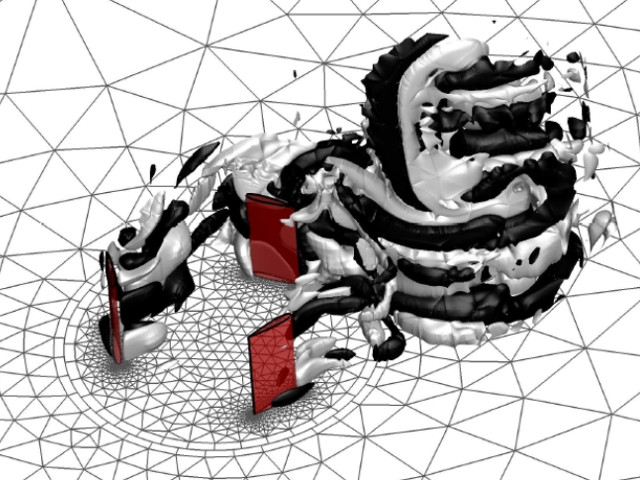
Recent progresses in aircraft aerodynamics have witnessed the introduction of surrogate-based approaches in design analysis and optimization as an alternative to address the challenges posed by the complex objective functions, constraints, the high-dimensionality of the aerodynamic design space, the computational burden, etc.
The masses of galaxy clusters are a key tool to constrain cosmology through the physics of large-scale structure formation and accretion. Mass estimates based on X-ray and Sunyaev–Zel’dovich measurements have been found to be affected by the contribution of non-thermal pressure components, due e.g. to kinetic gas energy.
T Wave Alternans (TWA) is a cardiac risk indicator which measures the functional cardioelectric instability substrate. Traditional estimation of TWA has been made on the surface ECG, hence providing the researcher with an anatomically non-specific marker.
3-D network-on-chip (NoC) is gaining popularity among designers due to scalability, higher bandwidth, fault tolerance, and reliability. However, the stacking of multiple dies leads to severe thermal problems due to increase in power density.