
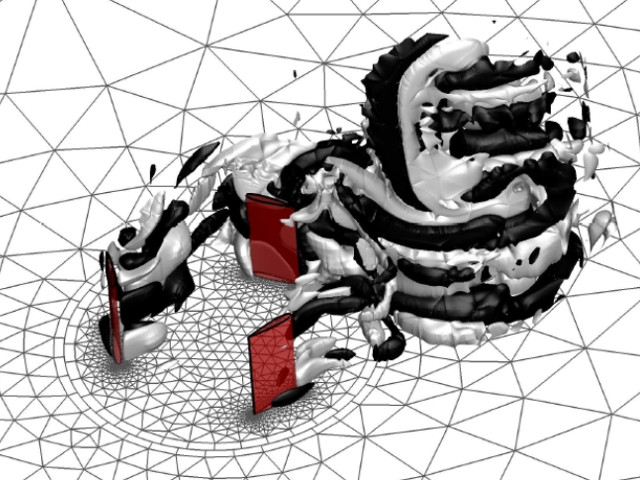





We present explicit and implicit large eddy simulations for fully developed turbulent pipe flows using a continuous-Galerkin spectral element solver. On the one hand, the explicit stretched-vortex model (by Misra and Pullin [45] and Chung and Pullin [14]), accounts for an explicit treatment of unresolved stresses and is adapted to the high-order solver.
We present a novel method for the determination of N-factors in cross-flow transition scenarios. The method considers numerical simulations, in which a turbulent model is applied downstream from a predetermined point and solves a laminar flow upstream from this point.
Hypertrophic cardiomyopathy, according to its prevalence, is a comparatively common disease related to the risk of suffering sudden cardiac death, heart failure and stroke. This illness is characterized by the excessive deposition of collagen among healthy myocardium cells.
Recent research has proven the existence of statistical relation among fragmented QRS and several highly prevalence diseases, such as cardiac sarcoidosis, acute coronary syndrome, arrythmogenic cardiomyopathies, Brugada syndrome, and hypertrophic cardiomyopathy.
When we interact with fluid media, e.g., with our hands, we experience a spatially and temporally varying pressure field on our skin, which depends on the density and viscosity of the fluid, as well as the relative motion between our hands and the surrounding flow.
The diverging requirements from various vertical industries have driven the paradigm shift in the next‐generation (5G) mobile networks, where network slicing has emerged as a major paradigm for this purpose by sharing and isolating resources over the same 5G physical infrastructure.