





Multiple Machine Learning solutions in Industry exist where interpretability is required. In retail, this is especially important when dealing with cold-start forecasting of promotional sales.
Ventricular fibrillation (VF) signals are characterized by highly volatile and erratic electrical impulses, the analysis of which is difficult given the complex behavior of the heart rhythms in the left (LV) and right ventricles (RV), as sometimes shown in intracardiac recorded Electrograms (EGM).
Many real-world problems can be formulated as the optimization of a continuous function. Furthermore, these problems are becoming increasingly more complex every year, reaching, or even exceeding, the thousand of variables. Evolutionary Algorithms have been traditionally successful at solving this kind of problems, due to their good balance in terms of solution quality and computation time.
Adversarial attacks represent a serious menace for learning algorithms and may compromise the security of future autonomous systems. A theorem by Khoury and Hadfield-Menell (KH), provides sufficient conditions to guarantee the robustness of active learning algorithms, but comes with a caveat: it is crucial to know the smallest distance among the classes of the corresponding classification problem.
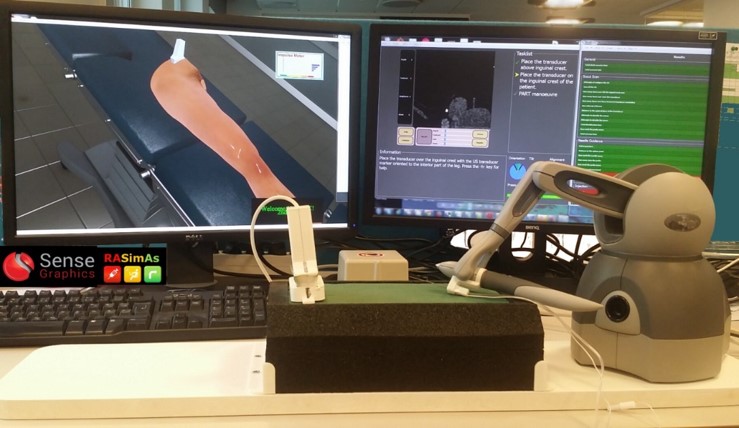
We present a method to render virtual touch, such that the stimulus produced by a tactile device on a user’s skin matches the stimulus computed in a virtual environment simulation. To achieve this, we solve the inverse mapping from skin stimulus to device configuration thanks to a novel optimization algorithm.
This paper introduces a method to simulate complex rod assemblies and stacked layers with implicit contact handling, through Eulerian-on-Lagrangian (EoL) discretizations. Previous EoL methods fail to handle such complex situations, due to ubiquitous and intrinsic degeneracies in the contact geometry, which prevent the use of remeshing and make simulations unstable.