





In this paper we analyze families of rankings by studying structural properties of graphs. Given a finite number of elements and a set of rankings of those elements, two elements compete when they exchange their relative positions in at least two rankings, and we can associate an undirected graph to a set of rankings by connecting elements that compete.
In this work, we propose a method to interactively deform high-resolution volumetric datasets, such as those obtained through medical imaging. Interactive deformation enables the visualization of these datasets in full detail using state-of-the-art volume rendering techniques as they are dynamically modified.
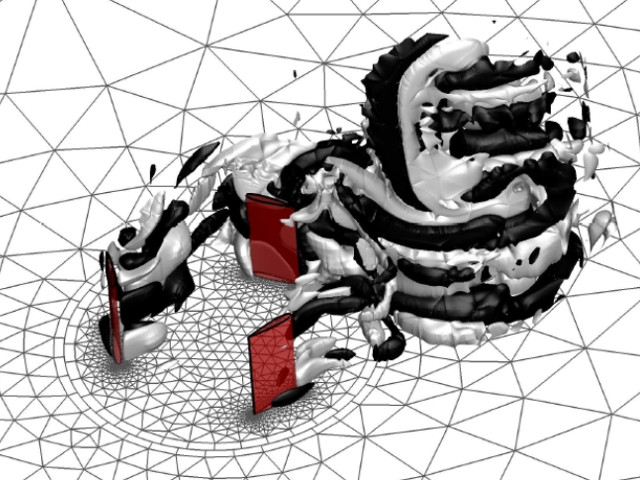
The stability of flow over a complex high-lift configuration with significant regions of separated flow is analyzed. Current state-of-the-art flow solvers encounter difficulties in predicting both the onset of flow separation over similar configurations and the progression of the separated region when the angle of attack is increased.
We use a cosmological simulation of the formation of the Local Group to explore the origin of age and metallicity gradients in dwarf spheroidal galaxies. We find that a number of simulated dwarfs form “outside-in”, with an old, metal-poor population that surrounds a younger, more concentrated metal-rich component, reminiscent of dwarf spheroidals like Sculptor or Sextans.
We provide a rigorous solution to the problem of constructing a structural evolution for a network of coupled identical dynamical units that switches between specified topologies without constraints on their structure.
In this work, we propose a method to interactively deform high-resolution volumetric datasets, such as those obtained through medical imaging. Interactive deformation enables the visualization of these datasets in full detail using state-of-the-art volume rendering techniques as they are dynamically modified.