




While the finite element method (FEM) has now reached full maturity both in academy and industry, its use in optimization pipelines remains either computationally intensive or cumbersome.
In reference [1], Liu and Vinokur proposed an strategy to derive a Roe-like linearization for flows in thermo-chemical non-equilibrium (TCNEQ).
High-order discontinuous Galerkin methods have become a popular technique in computational fluid dynamics because their accuracy increases spectrally in smooth solutions with the order of the approximation.
When a container with two distinct fluids is subjected to vibrations in microgravity, the interface may undergo a variety of instabilities and develop towards a complex structure, as seen in recent parabolic flight experiments using both miscible and immiscible liquids.
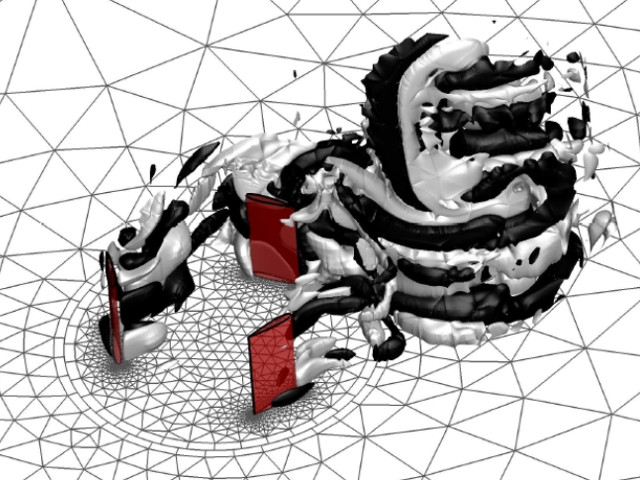
This Chapter presents a review on two methods for the analysis of flow structures in wind turbines. These methods are higher order dynamic mode decomposition and spatio-temporal Koopman decomposition, which are highly efficient tools suitable for the detection of spatio-temporal patterns in complex flows.
High-order discontinuous Galerkin methods have become a popular technique in computational fluid dynamics because their accuracy increases spectrally in smooth solutions with the order of the approximation.