



Authors
Alejandro Aguado; Victor López; Juan Pedro Brito; Antonio Pastor; Diego R. López; Vicente Martin
Conference Paper
https://doi.org/10.23919/ONDM48393.2020.9133024
Publisher URL
Publication date
July 2020
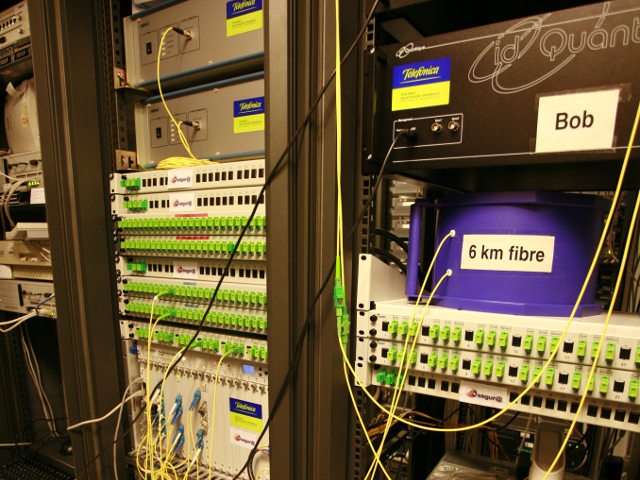
Quantum Key Distribution (QKD) is one of the major cryptographic solutions to tackle the security threats associated to future computational advances, in particular those coming from quantum computing. At the most simple level, QKD can be seen as a highly secure source of symmetric secret keys in two separated places. Nonetheless, the lack of standardization and the strong requirements from the physical layer makes this technology very difficult to integrate in existing infrastructure.However, the success of QKD networks radically depends on the degree in which they can be adopted in the existing infrastructure, and it is a must that it happens via standard protocols and interfaces. The flexibility of novel network paradigms, like Software-Defined Networking (SDN), allows for a faster adoption of new concepts, hardware and services in telecommunications networks. This paradigm can be used for quantum communications, allowing for a fast and scalable deployment of quantum technologies and services in the telecommunications network to a degree that was simply impossible in previous schemes, where the different network devices and their connections should be modified, one by one, to create a quantum communications channel.This tutorial provides an introduction to existing QKD technologies and networks, followed by a descriptive explanation on how SDN principles can be utilized to abstract and integrate QKD systems as part of the network management. This will help to reduce the time-to-market for quantum technologies, and also will make quantum cryptography available as a service to be capitalized by the network operators.